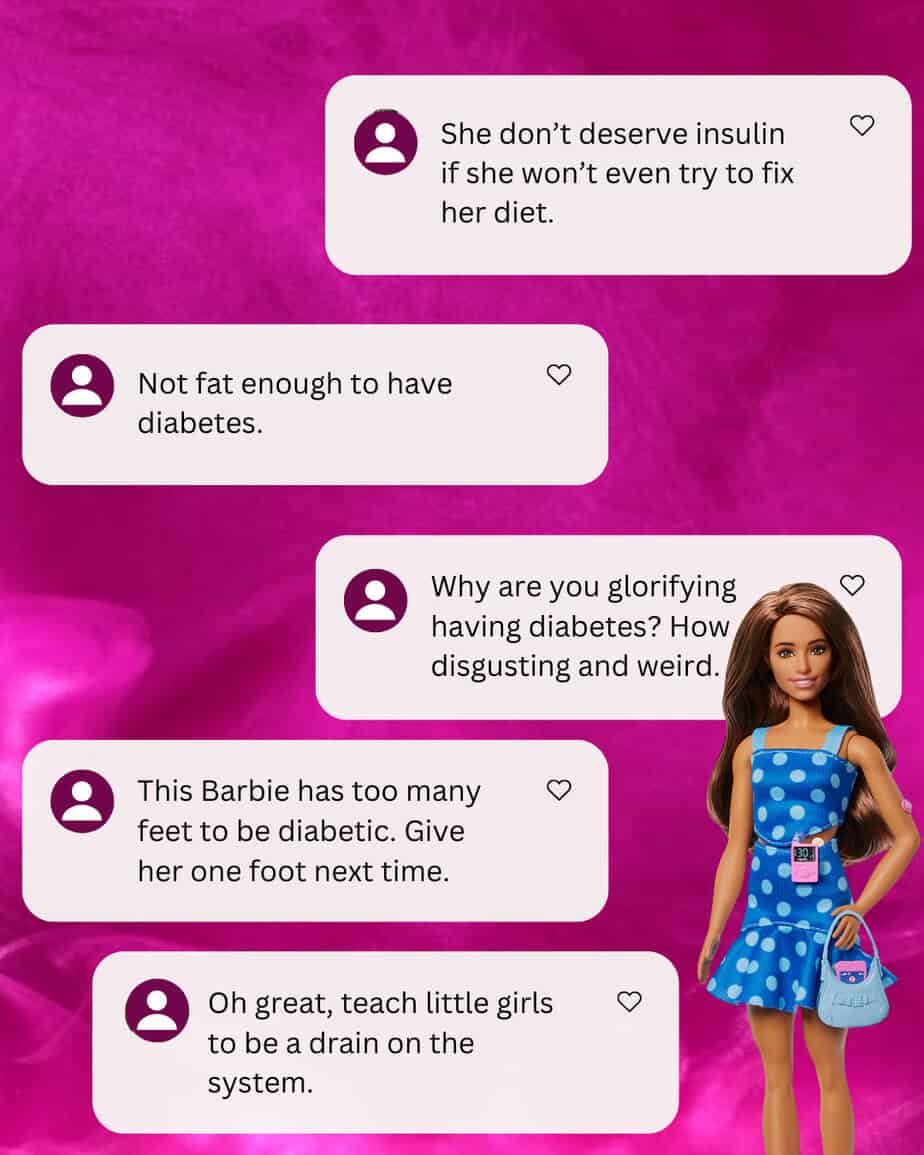

When Diabetes Barbie was released, the internet predictably imploded—both with celebration, but also with outrage, pearl-clutching, and performative concern.
The stigmatizing comments were a given. Debates about whether chronic illness belonged in the Barbie-verse at all were at the forefront. The response, was as disappointing as ever. Because at first there wasn’t any. And then I tagged Breakthrough T1D to say “Hey, this representation is amazing, but we the visibility comes with the responsibility to correct stigma and misinformation.”
It’s like that part was nowhere in the strategy. Just the excitement of partnering with one of the biggest brands in the world to bring visibility to diabetes. Which is great, but no one thought about the response?
And if you’ve spent any time living with or working in the world of diabetes, you could see this coming from a mile away.
As someone who’s been studying and advocating around diabetes stigma for years, this moment didn’t surprise me. Because every time we move one inch closer to meaningful representation, the same cultural alarm bells go off.
Not because people genuinely care about the wellbeing of those with diabetes—but because our existence challenges long-standing, deeply embedded biases about what chronic illness should look like. It also
When Stigma Comes From Inside the House
One of the most heartbreaking—and frankly infuriating—realities I’ve observed in my work is how stigma doesn’t just come from the outside. It often comes from within the diabetes community itself.
And yes, I’m talking about the divide between people with type 1 and people with type 2 diabetes.
In moments like the release of Diabetes Barbie, this divide gets sharper. I saw it in real-time—people with type 1 expressing frustration. Some said they didn’t want to be lumped in with “the other kind” of diabetes because it’s not at all the same (which is something else we have to dive a little bit deeper into).
Let me be clear: I understand where that fear comes from.
Type 1 diabetes is often misunderstood, and people with type 1 frequently have to explain that it’s an autoimmune condition, not something we “caused.” That gets exhausting because your health status has no place in morality. You don’t deserve more or less care, or resources regardless of diabetes type.
But here’s the truth no one wants to say out loud: That fear of being associated with type 2 diabetes is rooted in stigma.
It’s rooted in the false and damaging belief that type 2 is caused by personal failure. That it’s a disease of laziness, greed, or weakness. That people with type 2 deserve it.
And when people with type 1 try to separate themselves by throwing people with type 2 under the bus—saying things like “We’re not that kind of diabetic”—you’re not correcting misconceptions.
You’re reinforcing them.
They’re feeding the same system that says none of us are worthy of dignity unless we fit a certain image.
It shouldn’t matter what “type” of diabetes Barbie has.
A Step Forward with a Heavy Shadow
Representation is supposed to feel like a win.
But this felt complicated.
Because here’s the thing: while Barbie’s inclusion is a step forward, it also shines a very bright spotlight on how far behind the world still is in understanding diabetes—especially when it shows up in larger-bodied people, in Black and brown communities, in working-class families, and in anyone who doesn’t look like a pink, smiling doll.
These are the bodies that get judged the moment they mention their condition. The ones that are assumed to have “caused it” through laziness or poor choices. The ones that are constantly told to shrink, to hide, to stay silent unless they can present a palatable, apologetic version of what it means to live with diabetes.
If You Can Defend Barbie, You Can Defend a Real Human
If you can advocate for a doll, you can advocate for the person next to you being shamed for injecting insulin in public.
You can speak up for the coworker avoiding lunch because they’re afraid of being judged.
You can unlearn the myths about type 2 diabetes being a “punishment,” or fatness being a character flaw, or insulin being a sign of failure.
That hurt you feel seeing Diabetes Barbie called names or misunderstood?
That cringe? That defensiveness?
It’s the exact same pain people with diabetes—especially those with type 2, those in larger bodies, and those from marginalized communities—have carried for decades.
Every time diabetes is represented in the media, the assumption is that we must’ve done something wrong. That they deserve the diagnosis.
None of us do.
And the stigma we face isn’t just offensive. It’s dangerous.

The Real Impact of Diabetes Stigma
Here’s what I’ve learned over years of writing, researching, and building community around diabetes care:
- Stigma delays diagnosis.
- It causes shame and isolation.
- It leads people to skip medications, avoid medical appointments, or hide their condition.
- It increases the risk of depression and disordered eating.
- It contributes to misdiagnosis, especially in adults with LADA or MODY who are assumed to have “caused” their diabetes.
- And it hits hardest when someone’s identity doesn’t fit the mainstream narrative.
Stigma shows up in healthcare. In the media. In our language. In the way people think it’s okay to ask what someone ate, what they weigh, or why they “did this” to themselves.
And yes—it shows up even when a doll is given a diabetes device.

Let’s Be Honest About What’s Actually Offensive
A doll with a CGM and insulin pen isn’t offensive.
What’s offensive is pretending to care about stigma when real people with diabetes have been marginalized for years.
What’s offensive is watching a wave of empathy roll out for Barbie, while people still crack jokes about “diabeetus” or make assumptions about anyone over a size 12.
What’s offensive is still associating diabetes with shame instead of support.
Barbie having diabetes is not the problem.
The problem is the world’s inability to view people with diabetes as complex, deserving, human. And sometimes even within our own community.
What Real Advocacy Looks Like
If you felt something when you saw Diabetes Barbie being ridiculed—good. Hold onto that.
Now take it further.
- Speak up when diabetes is used as a punchline.
- Stop asking people how they “got” their diagnosis.
- Acknowledge that weight and health are not the same thing.
- Advocate for affordable insulin and equitable care.
- Uplift stories from people actually living with the condition—not just those who fit your comfort zone.
- And do all of it for everyone with diabetes – not just people with your time.
It’s easy to defend Barbie. It’s harder to challenge the systems that shame and fail people with diabetes every day.
Representation matters—but only when it’s paired with real-world respect.
Until we confront the biases that follow people with diabetes into doctor’s offices, into schools, into their own kitchens, then putting a CGM on a doll is just that: a symbol.
If you’re ready to move beyond the surface, beyond the outrage, beyond the empty conversations—then listen to the people who’ve been doing this work for years. We know how to solve stigma, but it starts with us first.