This content contains affiliate links, which helps hangrywoman.com to provide free recipes and resources. Thank you for your support of my blog and non-profit organization, Glucose Guide.
Want your recipes ad-free? Download the Glucose Guide App
Print
Prosciutto Pear and Walnut Salad
- Total Time: 15 minutes
- Yield: 2 servings 1x
- Diet: Diabetes-Friendly
Description
Make this prosciutto, pear and walnut salad with blue cheese and maple-lemon dressing, plus practical tips for fitting it into diabetes-friendly eating.
Ingredients
Salad ingredients
- 4.4 oz (125 g) arugula
- 1 ripe pear, peeled, quartered, cored and sliced
- 3 oz (85 g) blue cheese, cubed or crumbled
- 3.5 oz (100 g) ready-to-eat prosciutto, cut or torn into strips
- 4 tablespoons (about 29 g) walnuts, chopped
Maple lemon dressing
- 1 tablespoon (15 ml) olive oil
- 2 teaspoons (10 ml) lemon juice
- 1 tablespoon (15 ml) maple syrup
- Freshly ground black pepper, to taste
- Sea salt, only if needed
 Get Recipe Ingredients
Instructions
- Whisk the olive oil, lemon juice and maple syrup in a small bowl until combined. Add a little black pepper. Hold off on the salt until you’ve tasted the dressing with the ham and cheese.
- Divide the washed and thoroughly dried arugula between two bowls.
- Arrange half the pear, blue cheese, prosciutto and chopped walnuts over each bowl. Separate the prosciutto strips so you get a little in several bites.
- Whisk the dressing again, then divide it evenly between the salads. Taste and add salt only if needed. Serve immediately.
Notes
Dry the greens well. Water clinging to the arugula dilutes the dressing and makes the salad soggy.
Choose a ripe but firm pear. You want sweetness with enough structure to hold its shape. Very soft pears can break apart as you assemble the salad.
Spread the strong flavors around. Small pieces of blue cheese and loose ribbons of prosciutto give you a more balanced bite than a few large clumps.
Dress it when you’re ready to eat. Arugula is delicate. Keep the dressing separate until serving.
Make enough for your appetite. If you’d like bread or another side with your salad, that can fit too. Account for those additional carbohydrates rather than assuming the salad has to be the entire meal.
- Prep Time: 15 minutes
- Category: Salads
- Method: Chopping
- Cuisine: American
Nutrition
- Serving Size: 1
- Calories: 296
- Sugar: 8.5 g
- Sodium: 704.4 mg
- Fat: 14.8 g
- Saturated Fat: 8.7 g
- Carbohydrates: 22.2 g
- Fiber: 3.7 g
- Protein: 20 g
- Cholesterol: 55.2 mg
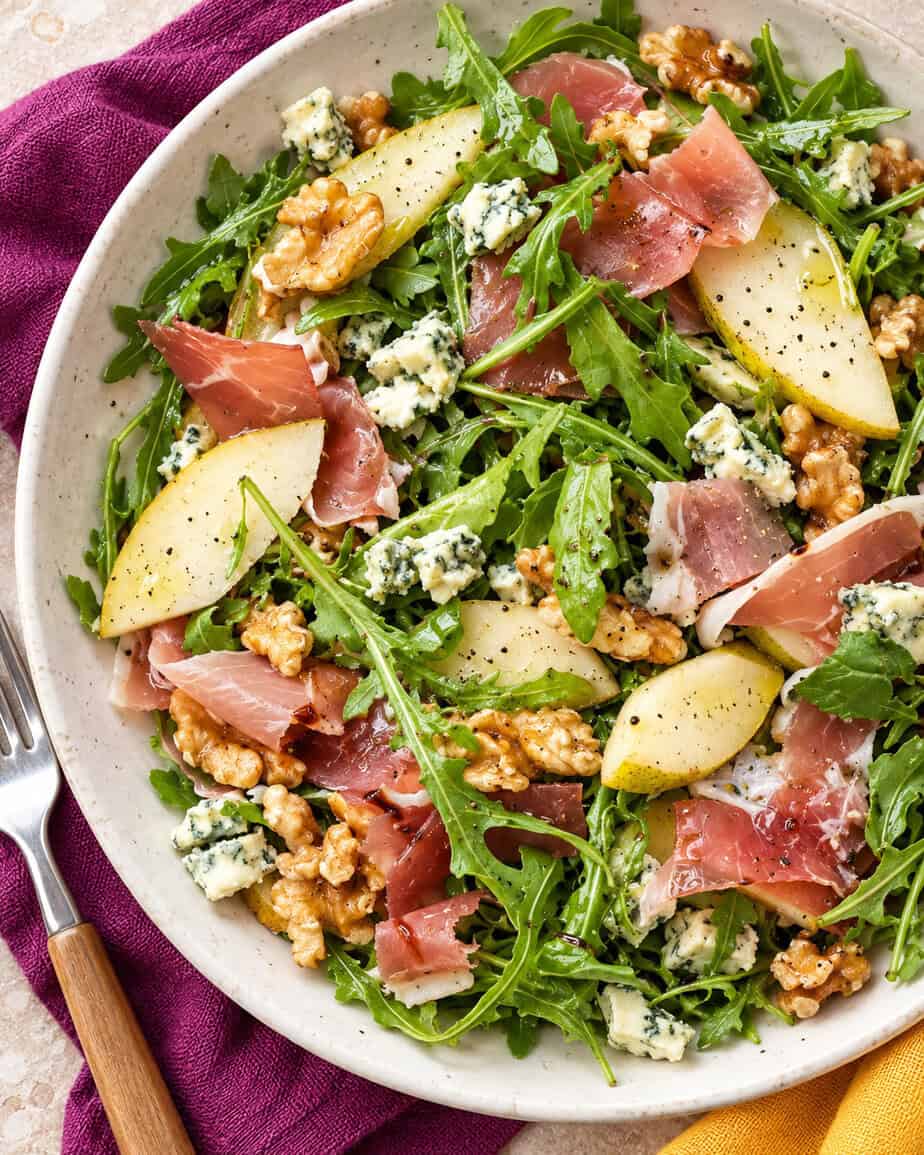
Salad should give you something to look forward to. This one has plenty going on – Sweet pear, salty prosciutto, tangy blue cheese, crunchy walnuts – and none of it requires turning on the oven.
This prosciutto, pear and walnut salad starts with peppery arugula and finishes with a simple maple-lemon dressing. It’s fresh, rich, sweet and savory in the same bite.
And yes, there’s both fruit and maple syrup in a recipe we’re talking about in the context of diabetes. You don’t have to remove every sweet ingredient to build a meal that works for you. Let’s talk about what each ingredient brings to the bowl and where the portions matter.
Why these flavors work together
Pears soften the sharpness of blue cheese, while prosciutto adds a savory, salty bite. Arugula keeps everything from feeling too rich. Walnuts bring the crunch that makes a salad feel like something you actually want to keep eating.
The dressing connects it all: olive oil for richness, lemon juice for brightness, and a little maple syrup to round out the peppery greens and tangy cheese. You only need three ingredients and a bowl.
How this salad can fit into diabetes friendly eating
“Diabetes friendly” doesn’t mean a food guarantees a certain blood sugar result. It means looking at the ingredients, portions and overall meal in the context of your needs. Here’s how that plays out in this salad.
Arugula gives you a generous vegetable base
Arugula, also called rocket, is a non-starchy vegetable. It adds volume and nutrients with relatively little carbohydrate. This recipe divides 125 grams of greens between two bowls, so the vegetables have a real place in the meal.
If the peppery flavor feels a little strong, swap some of the arugula for baby spinach.
Pear brings sweetness and fiber
Fruit belongs in the conversation about eating well with diabetes. Pear contributes carbohydrate, along with fiber, and the recipe uses half a pear per serving. The size of that pear matters when you’re estimating carbs.
The original recipe calls for peeling it. You can also wash it well and leave the skin on for texture and to retain the fiber in the peel. Either way, choose a pear that is ripe but firm enough to slice.
The takeaway: you can enjoy the pear and account for it. You don’t need to treat it like an ingredient you’re getting away with eating.
Walnuts and olive oil bring unsaturated fats
Walnuts add crunch and mostly unsaturated fats, including the plant omega-3 fat ALA. Olive oil contributes mostly monounsaturated fat. Choosing more unsaturated fats in place of saturated fats supports a heart-conscious eating pattern, which matters alongside blood sugar management.
The amounts here are straightforward: each serving gets about 2 tablespoons of chopped walnuts and ½ tablespoon of olive oil. These foods still contribute energy, and their fats don’t cancel out the carbohydrates in the bowl.
Prosciutto and blue cheese add protein and plenty of flavor
Both ingredients contribute protein. They also bring sodium, and blue cheese contributes saturated fat. This is a flavorful salad, but it isn’t automatically a low-sodium or low-saturated-fat meal because it has greens underneath it.
Taste before adding salt. You may find the ham and cheese provide all you need.
For a version with less cured meat, replace some or all of the prosciutto with unbrined cooked chicken. You can also use less blue cheese and crumble it finely so its flavor reaches more bites.
Maple syrup is still added sugar
Maple syrup tastes lovely with pears and walnuts. It is also added sugar, and being maple syrup doesn’t make it blood-sugar neutral.
The full dressing contains 1 tablespoon, which works out to 1½ teaspoons per serving when divided evenly.
Include it when counting carbohydrates. If your pear is especially sweet, you can start with less syrup and adjust to taste.
The lemon juice balances flavor. It doesn’t erase the sugar.
Let me know how this recipe turns out for you, any changes or modifications you make, and how it worked for your blood sugar. I can’t wait to hear!