No one likes pricking their finger every single day to check their blood sugars. But, it’s an unavoidable part of having diabetes.
If you want to understand your blood sugar patterns, you have to test your blood sugars.
But, technology has evolved, and fingersticks are just one way to monitor blood sugars.
Enter, Continuous Glucose Monitors (CGMs).
CGMs make diabetes management a whole lot easier.
They allow a person with diabetes more freedom, more data, and a reprieve from sore fingers with multiple daily fingersticks.
This article explores everything you need to know about continuous glucose monitors and if the technology is right for you.
In This Article
- What is a continuous glucose monitor?
- How does a Continuous Glucose Monitor Work
- Who can use a continuous glucose monitor?
- Where can you wear your CGM?
- How does a CGM differ from a glucose monitor
- What are the benefits of a CGM?
- What brands of CGMs are out on the market
- How much do continuous glucose monitors cost?
- Are there patient programs and discounts for continuous glucose monitors?
- How do you get a continuous glucose monitor?
- The bottom line on CGMs
What is a continuous glucose monitor?

A continuous glucose monitor, or CGM, is an FDA-approved medical device that provides real-time continuous readings of interstitial fluid.
CGMs measure readings through a sensor implanted under the skin and connected to a monitor with a small transmitter.
There are different types of continuous glucose monitors, including those that can transmit data wirelessly, super continuous monitors, and continuous glucose sensors.
How does a Continuous Glucose Monitor Work
A continuous glucose monitor works by analyzing interstitial fluid (not blood) continuously throughout the day and night via a sensor implanted just under your skin.
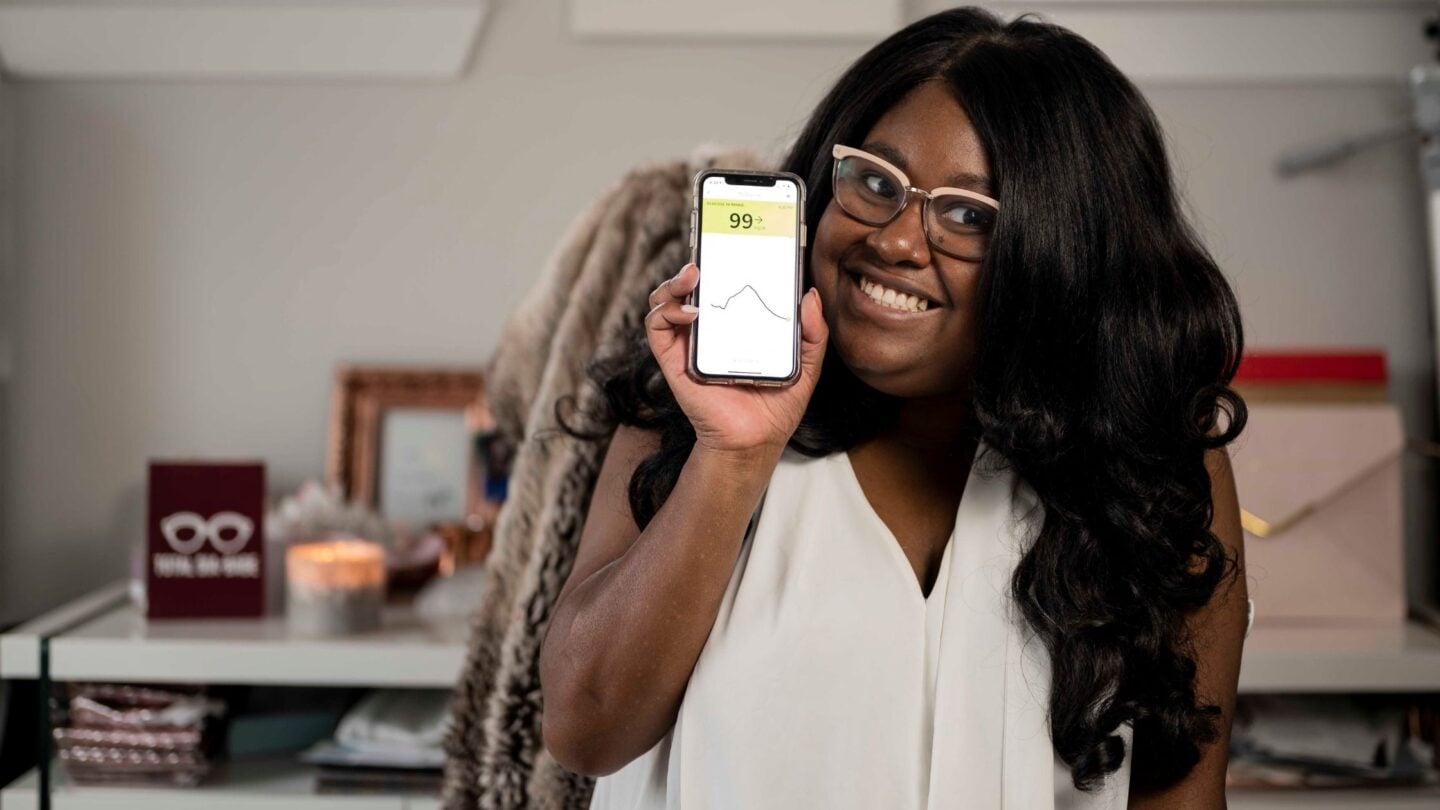
A continuous monitor does not need frequent fingersticks but instead uses sensors that continuously read sugar in your interstitial fluid and send data wirelessly to an app on your smartphone or another device like a smartwatch or the CGMs receiver.
There might be times your CGM needs a fingerstick calibration to make sure it is accurate.
This continuous data means having more information to decide how to move forward with your diabetes management.
CGM’s are typically worn for a week or longer to get an accurate reading.
Who can use a continuous glucose monitor?
CGMs are FDA approved for use in people with most types of diabetes. That includes Type 1, Type 2, LADA, MODY, 3c. CGMs are not yet recommended during pregnancy or for Gestational diabetes.
Have a conversation with your doctor to decide if a CGM is right for you.
Additionally, people without diabetes are starting to use CGMs alongside metabolic health companies using the devices off-label and not in line with the FDA-approved guidance.
This kind of use is controversial in the diabetes community, as CGMs are not a diagnostic tool for diabetes, and people with diabetes already have significant access barriers when obtaining and using CGMs.
Where can you wear your CGM?
You can wear your CGM on the upper arm, belly, or thigh, depending on the brand you’re using.
Your CGM will come with a set of instructions that outlines which placement is best for you.
However, continuous monitors are often worn on the arm because it’s easy to do your blood sugar readings from this location and provides an accurate reading in most people without much irritation.
How does a CGM differ from a glucose monitor
A continuous monitor is typically worn on the body, where a traditional glucose meter is not worn.
A continuous glucose meter means you don’t have to constantly check blood sugar levels throughout the day by pricking your finger with frequent fingersticks or relying on memory recall.
With both types of tech, numbers are automatically logged, so finding your readings is easy.
What are the benefits of a CGM?
There are several benefits to a CGM:
– Accurate continuous readings throughout the day and night
– Provides alerts for low or high levels
– Freedom from fingersticks
-Not having to carry a separate device to check and track your blood sugars.
-Can be used in Automated Insulin Delivery Systems.
On the flip side, CGMs can be expensive, they are not always covered by insurance plans, and if they do fail, it can take a lot of time and effort to replace them.
What brands of CGMs are out on the market
There are currently many continuous CGM’s available for people with diabetes.
Some popular ones include Dexcom, Medtronic, Eversense, Omron, and Freestyle Libre.
These brands provide different features depending on your needs and budget. For example, some use predictive alerts for lows and highs, while others have continuous glucose monitors that are disposable.
Each brand varies in price and the length of time it works.
How much do continuous glucose monitors cost?
The upfront costs of continuous wear monitors vary greatly depending on the type you choose and how often it needs to be replaced or charged.
A CGM can vary from $150 to a few hundred dollars per month out of pocket, depending on the CGM you choose.
Your insurance coverage or out-of-pocket costs will generally determine the cost and how many sensors you need each month.
Are there patient programs and discounts for continuous glucose monitors?
Some companies do give patients a break. Most of these require commercial insurance.
Programs for people with commercial insurance:
Freestyle Libre
Maximum of $75 for 2 sensors (28 day supply), $65 for reader
MyFreeStyle program, 1 free sensor and reader
Medicare not eligible for either of the above but can look for discount card programs.
For more information about these programs and others visit Abbott
Dexcom
Products: Dexcom G6
Programs for people with commercial insurance:
$45 for 90-day supply: includes 1 transmitter (90-day wear) and 9 sensors (10 days wear/sensor).
Maximum of 2, 90-day supplies.
For more information about these programs and others visit Dexcom or Dexcom Patient Assistance
Ascensia
Products: Eversense
Programs for people with commercial insurance or no insurance
After the first $100, Ascensia covers the next $300 per sensor (90 days).
Maximum savings of $1,200 per year.
Must be 18 years or over
For more information about these programs and others visit Acenscia
Medtronic
Products: Guardian 3, Guardian Connect
Programs for people without insurance coverage for Guardian sensors, includes those with Medicare:
Cost is reduced to $180 per transmitter (12-month warranty) and $60 per box of 5 sensors (7-day wear/sensor).
For more information on this program visit CGM Access Discount
Other Medtronic Programs:
If recently lost your job or health insurance, you can receive up to 3 months of sensors at no cost.
Defer payments for up to 3 months if you or a family member is laid off or furloughed from job.
Additional financial assistance is also available. Call 1-888-350-5540, M-F, 8 am – 6 pm CT or visit Medtronic Assurance
How do you get a continuous glucose monitor?
Ask your doctor about different options, and the pros and cons of each. If you have one in mind, some brands offer a trial period where you can wear one and see how it fits your lifestyle before committing to one specific brand.
Your doctor will need to write a prescription for you to use.
The bottom line on CGMs

Continuous glucose monitors can help people with diabetes to better manage their blood sugar levels.
However, continuous monitors are not a cure-all and should be used in conjunction with other care methods recommended by your doctor or healthcare provider.
They can make life with diabetes just a little bit more care-free and provide more stats and data to help your doctor give you the right treatment plan for your numbers.