This content contains affiliate links, which helps hangrywoman.com to provide free recipes and resources. Thank you for your support of my blog and non-profit organization, Glucose Guide.
Most people think blood sugar management is only about what you eat.
Fewer people realize it can also be about how you eat it. Specifically — the order.
As a public health nutritionist and board-certified health and wellness coach, If something works, I want to know why. And if it’s practical, even better.
So let’s talk about food order, mixed meals, and what the research actually says.
One of the foundational studies on this topic looked at people with type 2 diabetes and tested what happened when they ate the exact same meal in different orders.
Participants ate carbohydrates first, or protein and vegetables first followed by carbohydrates.
When protein and vegetables were eaten first, post-meal glucose levels were significantly lower.
In some cases, the glucose rise was reduced by more than 30 percent compared to eating carbohydrates first.
Same meal. Different order. Different glucose response.
More recent research continues to support the idea that meal sequencing — particularly eating fiber and protein before carbohydrate — improves after meal glucose control and overall blood sugar management. It can also be maintained long-term
What happens to blood sugar with a veggies first approach
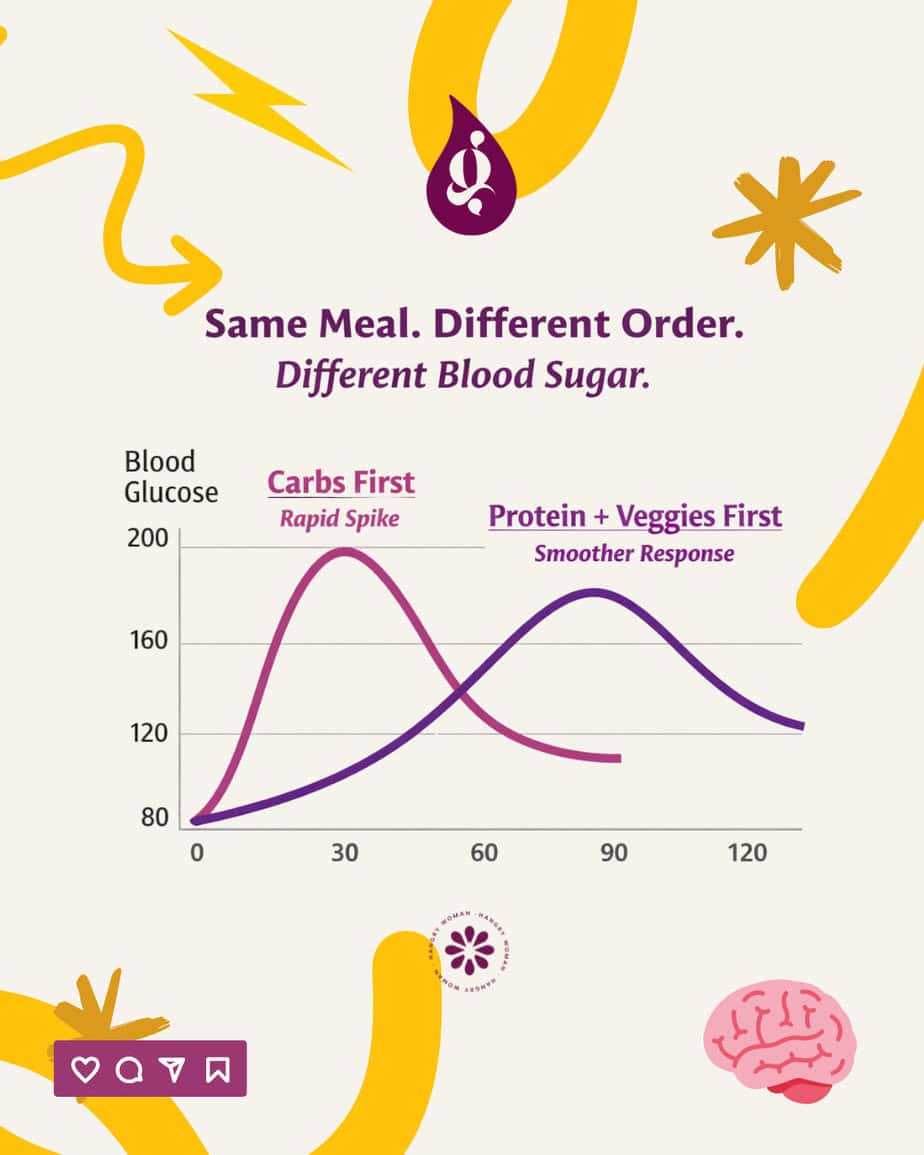
When you eat carbohydrates like starches, or sugar alone or first, they digest quickly and glucose enters the bloodstream rapidly, leading to a sharper spike.
When you eat protein and fiber first, gastric emptying slows, meaning food leaves the stomach more gradually.
Carbohydrate absorption slows. Insulin response becomes more coordinated. The spike becomes a slope.
That difference matters over time because post-meal spikes out of range are one of the contributors to elevated A1C levels.
Now let’s address real life. Most of us are not eating components separately.
We’re eating stir-fries, burrito bowls, pasta dishes, smoothies, sandwiches, and casseroles.
So how do we apply sequencing research when everything is mixed together? The answer is not to take your taco apart. The answer is to think about meal structure.
The benefit of food order comes from slowing glucose absorption.
You can recreate that effect in mixed meals by anchoring meals with enough protein, including meaningful fiber, and avoiding large isolated carbohydrate loads.
Think in ratios instead of rigid rules. If your plate is mostly carbohydrate with a small amount of protein, glucose will likely rise more quickly.
If your plate is protein-forward with carbohydrates layered in, digestion slows and blood sugar response is often more stable.
For example, instead of a large bowl of rice with a small serving of chicken, try reducing the rice slightly, increasing the protein, and adding vegetables.
Instead of toast with jam alone, try eggs first and then toast, or eggs and toast together so the protein buffers the carbohydrate.
Instead of a fruit smoothie alone, add protein powder, nut butter, chia seeds, and unsweetened milk to slow absorption. In each of those examples, you’re giving your carbs a good buffer.
There’s also the role of food structure.
Whole, minimally processed carbohydrates digest more slowly than refined or highly processed ones. Brown rice behaves sightly differently than white rice (but not much).
Whole fruit behaves differently than juice. Steel-cut oats behave differently than instant oats.
Physical structure influences how quickly glucose enters the bloodstream, even when the total carbohydrate amount is the same.
What I love about this research is that it reframes the conversation. You don’t have to eliminate carbohydrates to improve blood sugar response.
You don’t have to eat your dinner in isolated sections forever. But understanding digestion gives you leverage. The order you eat your food can influence your glucose response.
The structure of your meal matters. And when you combine protein, fiber, and intentional carbohydrate planning, you create meals that work with your metabolism instead of against it.
If you use a CGM or check post-meal glucose, try experimenting.
Eat the same meal twice on different days. One day eat carbohydrates first. Another day eat protein and vegetables first.
Compare the peak and timing. Or keep carbohydrates the same and increase protein and fiber. Observe the difference. Your body provides useful feedback when you give it structure.
Blood sugar balance is not about perfection. It’s about reducing volatility. Small structural shifts — repeated consistently — can produce meaningful long-term change.
References
- Indarto, D., Rochmah, D. N., Wiboworini, B., Pratama, Y. M., & Wibowo, Y. C. (2022). Effects of Vegetables Consumption Before Carbohydrates on Blood Glucose and GLP-1 Levels Among Diabetic Patients in Indonesia. International journal of preventive medicine, 13, 144. https://doi.org/10.4103/ijpvm.IJPVM_704_20
- Shukla, A. P., Iliescu, R. G., Thomas, C. E., & Aronne, L. J. (2015). Food order has a significant impact on postprandial glucose and insulin levels. Diabetes Care, 38(7), e98–e99. https://pubmed.ncbi.nlm.nih.gov/24426184/
- Zhang, X., et al. (2024). Effects of meal sequencing on postprandial glycemic control: A systematic review and meta-analysis. https://pubmed.ncbi.nlm.nih.gov/39777075/